
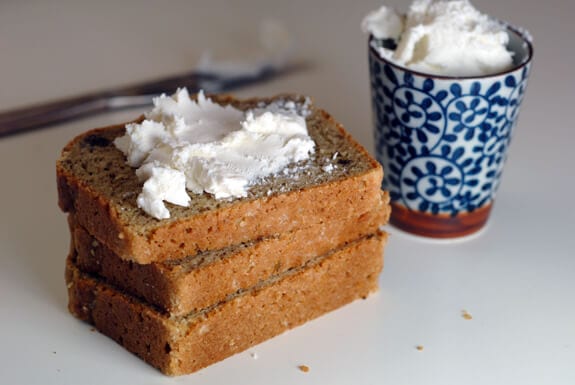
Hello Mark’s Daily Apple readers! Be sure to check out my Paleo Bread recipe.
This gluten-free bread recipe is perfect for sandwiches. Made with 7 ingredients –almond flour, arrowroot, flax, eggs, baking soda, salt, and vinegar– it’s also super easy to make! If you’re feeling a bit lazy this gluten-free bread is great to have around for an easy dinner, or what we call “sandwich night.” Just slice and toast this delicious bread, then put it out with organic turkey slices, romaine lettuce, sliced tomatoes, dijon mustard, primal kitchen mayo, and (if you can eat dairy) sliced cheese. Serve the sandwich fixings along with a big tossed green salad and dinner has practically made itself.
We also serve this easy gluten-free bread recipe toasted and spread with my homemade goat cheese, or dipped in olive oil.
Bread 2.0
Ingredients
- 1½ cups blanched almond flour (not almond meal)
- ¾ cup arrowroot powder
- ¼ cup golden flaxmeal
- ½ teaspoon celtic sea salt
- ½ teaspoon baking soda
- 4 large eggs
- 1 teaspoon apple cider vinegar
Instructions
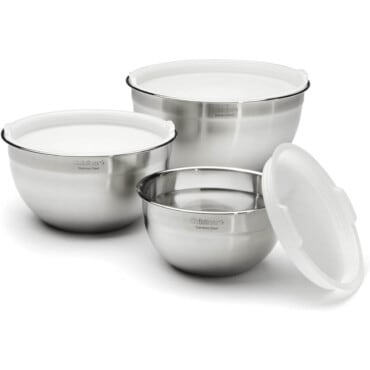
- In a medium bowl, combine almond flour, arrowroot, flax meal, salt, and baking soda
- In a large bowl, blend eggs for 3 minutes until frothy
- Stir vinegar into eggs
- Mix dry ingredients into wet
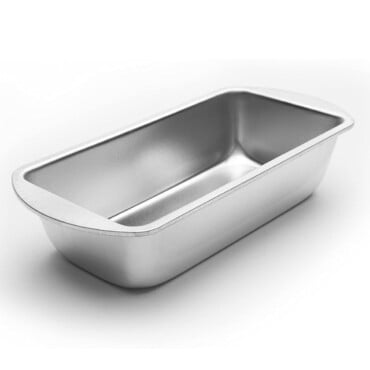
- Scoop batter into a well greased 7.5 x 3.5 inch magic line loaf pan or 7.5 x 3.75 inch fox run pan
- Bake at 350°F for 30-35 minutes, until a toothpick inserted into center comes out clean
- Cool and serve
To store this bread, wrap in a paper towel, seal in a plastic bag, and refrigerate for up to 1 week.
I hope you enjoy this quick and easy bread! It’s full of fiber (from the almond flour and flaxmeal). I call it “Gluten Free Bread 2.0” because it is the second gluten-free bread recipe I’ve created for this site. The first gluten free bread recipe was my Simple Bread, that easy bread recipe has only 6 ingredients!
This loaf yields a medium size slice, not as big as a regular slice, though is very filling, so I slice it thinly, as not to overload on bread. I use this magic line loaf pan for many of my bread recipes –it distributes the heat evenly and bakes the bread through, which is not always easy when baking with almond flour which tends to be rather moist.
When not using this easy gluten-free bread recipe for sandwiches, one of my favorite ways to serve it is toasted with one of these easy paleo soup recipes:


Laura says
Elana,
Just made the bread today with the Honeyville Almond Flour you suggested ordering online. It tastes great and was so easy to make! Going to try some of your other recipes. Thanks!
j.cro says
HI Elana,
Actually, this is the recipe I made over the weekend –
Sadly I didn’t have blanched almond flour and was too lazy to go to the store to get some so I substituted with a mix of Buckwheat and Sorgham instead.
I’m not really sure what happened – the “batter” wasn’t batter at all – it was most definitely dough – which was a bit heavy.
I put it in my pan and baked it for 30 minutes and it came out fine, if a little bit dense.
I’m wondering if the buckwheat/sorgham combo is more dense than blanched almond flour?
I’m excited to try this again with the right kind of flour but in the event I don’t have it, can you please recommend an appropriate substitute (aside from rice, please)? Maybe quinoa might work nicely? I guess I’ll have to try!
Ninufar says
Hi j.cro,
I’m no kind of expert, but my understanding is that almond flour absorbs far less liquid than grain (or grain-like seed) flours do. & by now you may have seen the FAQ page with answers to general substitution questions, but I’ll go on anyhow…
If you just want to try almond flour out, this recipe does work with plain ol’ Bob’s Red Mill blanched almond meal, which is easiest for me to find in stores. If you want to practice making breads with sorghum or buckwheat flour it might help to also visit blogs of GF cooks who do use grains. (I don’t think Elana uses grains or buckwheat at all. Some handy sources are glutenfreegoddess.blogspot.com and milkforthemorningcake.blogspot.com — I have no connection to any of these folks beyond a yearly comment or so, and I hope noone minds my listing them.)
Peace!
Johanna says
I just made this bread last night for breakfast this morning. It is the first bread we have tried that we actually like since finding that we are allergic to wheat, gluten, and 12 other foods. I am wondering if I can make several loaves at once and freeze them? Will they come out of the freezer well?
~M says
Hi Elana!
I just adore this bread! Anyway, I was wondering whether you’ve considered making a cinnamon raisin bread..I think the nuttiness of the flax-almond mixture would work wonderfully with cinnamon and raisins!
Best of luck with your new book. I can’t wait to get it in the mail!
~M says
Hi Allegra, I would try another starch, such as tapioca starch (aka tapioca flour), cornstarch, or potato starch (not potato flour). But I believe that these three starches have a higher glycemic index, and they lack the calcium ash that arrowroot has. Here is some information on arrowroot’s properties: http://www.morethanalive.com/Arrowroot-powder
If you choose to sub one of the other starches, I might start by using a bit less since they are starchier/gummier, in my unprofessional opinion. You can always add a spoonful, but can’t take away. :)
Good luck and please be sure to post back and let us know what you find out! There may be other readers with the same question.
~M says
Thanks! I am interested in science so seeing the research myself is so helpful!
Allegra says
does anyone have a substitute for arrowroot powder?
Jessica says
i would try the forums…
sugarfreedom says
I use cheakpeas or yucca or yam flours, they all come up very good, and each have a diffrent flavor.
Amy says
M – It’s flax oil that shouldn’t be heated, not flax seed. It’s perfectly fine and normal to use flax seed and meal in cooking and baking. So don’t worry about it!
~M says
If you have a source for this, I’d like to see it. Wouldn’t the flax seeds (ground or whole) still contain the oil that goes rancid/oxidizes when exposed to heat?
Besides chia/salba, I wonder if ground psyllium (yes, the same stuff that’s in Metamucil) would work as an alternative for those avoiding flax…I’ve used it as a binder before when making glutenagogo’s pear pancake.
Amy S says
M – Here is what my nutritionist sent me (part of the Adobe doc.) from the flax council. If you want the whole thing, I would need your e-mail: “Baking effects:
ALA in whole and milled flaxseed also appears to
be stable to heat equal or greater than the
temperatures involved in baking batters and doughs
such as muffins and yeast bread. Thermal stability was shown in 1992 by the absence of significant changes in peroxide values and fatty acid composition when both forms of flaxseed were heated for 60 minutes at either 100°C (212°F) or 350°C (662°F). Furthermore, gas liquid chromatography showed no signs of new trans isomers of ALA or of cyclic fatty acid formation in samples subjected to these degrees of heat5. In a follow-up study the proportion of ALA in the fat of a muffin mix, where 28.5% of the formula was milled flaxseed, was virtually unchanged after baking at 178°C (350°F) for 2h (45.1% ALA before:45.0% after). This stability was observed even though oxygen consumption of the flaxseed muffin mix was considerably greater than that of the control muffin mix6. A subsequent study confirmed the stability of ALA in baked muffins containing the same amount of milled flaxseed and noted that thiobarbituric acid values, as estimates of ALA oxidation were also unaffected by baking9. On reflection, the baking stability of ALA should not be surprising considering that the internal temperature of a muffin approaching doneness would not be expected to exceed the gelatinization temperature of starch. Wheat flour in the presence of sugar, or honey in this instance, would gelatinize around 95°C (203°F),
much lower than the temperature of hot air in the oven from which heat is transferred to the baking product.
A further margin of safety for the ALA-conscious
consumer is the fact that muffins are usually baked for only 20-25 min. at 204-208°C (400-425°F) in contrast to some experimental conditions4.
Biological evidence also supports the stability of
ALA to baking temperatures. Nine college women
included 50g flaxseed in their daily diet for four
weeks in one of two ways. Five of them added milled Flaxseed flaxseed, uncooked, to the food of their choice such as breakfast cereal, soup, juice or yogurt. The other four consumed bread baked with milled flaxseed (250g/kg) rather than their usual bread. Plasma fatty acid profiles during the four-week study were not significantly different between the women eating raw milled flaxseed and those eating the same amount of flaxseed baked in bread. Both subject groups
exhibited a lowering of serum total cholesterol and low-density-lipoprotein cholesterol10. The implication is that baking had no effect on the bioavailability of flaxseed fatty acids.
Lorain says
Well, since my diagnosis last November I have longed for a decent gluten free bread….I just can’t even look at rice bread. I tried a few complicated recipes and finally gave up–that is until now. I love this recipe. As I did not have arrowroot powder, I subbed tapioca flour–I then used maple syrup instead of agave (don’t like the stuff)and because flax can be a problem with thyroid meds I used half flax and half salba seeds for the flax meal. A delicious loaf!!
Thanks so much, I can enjoy my bread again.
Amy says
Well, my first batch came out 2″, but a firm slicing texture. My 2nd batch (after whipping for 5 min. and using room temp eggs) was 4″ but the top was crumbly and it stuck to the pan (haven’t sliced it yet). The 2nd batch tasted better, less eggy. I cheated and added 1/2 tsp of gluten free baking powder. Not sure if it helped or hurt. I think I will try it with the baking powder and no vinegar and see.