
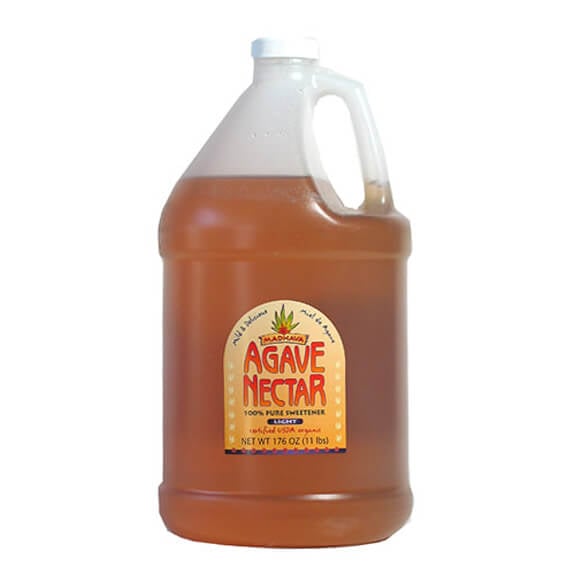
“Why do you use agave? I’ve heard that it’s very unhealthy” I’m asked this question about my “go to” sweetener on at least a daily basis.
First off, there really is no perfect sweetener, so I recommend everything in moderation.
We often take sugar and other sweeteners for granted, forgetting that they were not widely available to humans until the modern era (excluding of course, those living in the tropical regions feasting on mangoes and pineapple). Processed sugar was invented between the Medieval Period and the Enlightenment (more than 500 years ago), it became more widely available during the 1400 and 1500’s. By 1750 (with the advent of the Industrial Revolution and the invention of sugar mills) sugar became wildly popular.
So if we really think about it, up until a couple of hundred years ago, the majority of the human race (at least those living in colder climes) only experienced the taste of sweetness by eating fruit when it was in season (or when nursing, of course). The fruit that was eaten was not the overly ripe, super sweet fruit that is bred today. Think of wild blueberries –they are tiny and tart. The fruit we eat today has been cultivated for its juicy, sweet flavor.
I think the spike in diabetes and other diseases we have seen during the past decades may partially be due to the fact that humans are not accustomed to eating large quantities of sugar and are not able to efficiently metabolize this substance.
Sugar is sugar. Agave is sugar. An apple is sugar with some good vitamins, minerals and fiber. Basically, many of us (especially those with celiac) would be prudent to monitor our intake of sugar in any form (celiac and diabetes ride on the same HLA gene, so the presence of one increases the likelihood of the other).
While I do use agave in my dessert recipes, I am very cautious about my overall intake of this (and all other sweet substances) because I find that unfortunately, I am one of those whose body rebels against too much sugar. Of course, my husband and children can eat a lot more of this substance than I do and still feel great. That’s what keeps me baking like a fiend. They want their treats and they do just fine with them.
For those of you that are now on the anti-agave bandwagon, I have come up with this date sweetened recipe. Of course, I will still be using agave because I feel ok when I consume it in very small amounts.
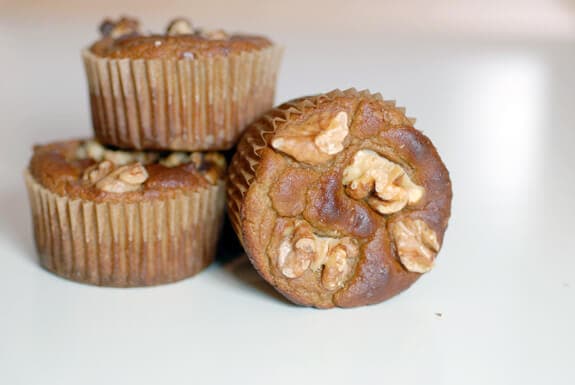
Banana Walnut Muffins

Ingredients
- 3 large eggs
- ¼ cup coconut oil
- 2 medium bananas
- 3 dates (remove pits)
- 10 drops stevia
- ¼ cup coconut flour
- ¼ teaspoon celtic sea salt
- ½ teaspoon baking soda
- ½ cup walnuts, toasted and chopped
Instructions
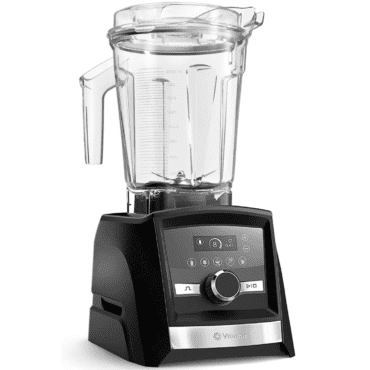
- Place eggs, oil, bananas, dates and stevia in a vitamix; blend on medium speed until combined
- Add in coconut flour, salt and baking soda and blend until smooth
- Fold in walnuts
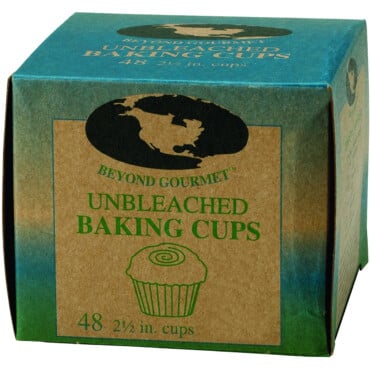
- Scoop ¼ cup batter into a paper lined muffin pan
- Bake at 350°F for 20-25 minutes (my batch took exactly 23 minutes; all ovens are slightly different)
- Cool and serve
Equipment
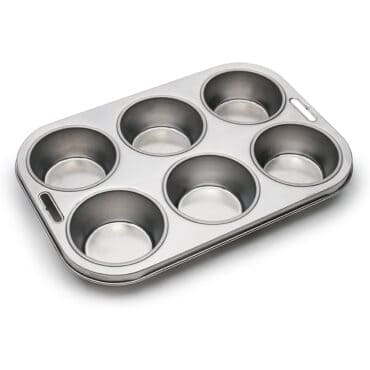
These tasty gluten-free, Paleo (I think) muffins do not contain agave for all of the agave-phobes out there. I will be creating some desserts with alternative sweeteners just to spice things up (plus, I like a good challenge every now and then). However, I will still be using agave for some recipes.
In terms of the great agave debate, I want you all to know that I use Madhava Agave Nectar. While I’ve noticed a lot of your comments with links to articles about the evils of agave syrup I want to also point out this link posted by one of my readers, Shari, from Madhava’s President Craig Gerbore.
On a much lighter note, here’s a cool coincidence in regards to agave nectar. The winner of last weeks Freebie Friday is Karen from wrighttherapies.com. She left an interesting comment regarding the controversy over agave nectar on my Asian Salad Dressing post.
Agave or not, have a great weekend!
UPDATE: please visit Madhava’s Agave MythBuster website for more information on the agave debate.



Deb Schiff says
Elana, I know how you feel. Over the years, I’ve done my share of posts on why I use agave, etc. Even had Craig, the president of Madhava guest post on my site to address issues (read: false information) that have been circulating around the web.
It takes a lot of energy to keep up with everything and to try to correct people when they are under false assumptions. So, I decided not to do that anymore except from my blog.
On the other hand, I’ve watched over the years (and tracked via Google alerts) how popular agave nectar has become and has grown as a product. Just this week, the New York Times did a little bit on it in terms of bar drinks, but nonetheless…
Anyhoo, just writing to say thanks for saying your piece.
A says
@Alchemille – with stevia, I believe there are studies showing no reproductive effects as well. These are some papers I’ve seen cited as examples of the other side of the debate (I haven’t read any of them):
Roberts, A., Renwick, A.G., Comparative toxicokinetics and metabolism of rebaudioside A, stevioside, and steviol in rats, Food and Chemical Toxicology (2008)
Brusick, D.J., A critical review of the genetic toxicity of steviol and steviol glycosides, Food and Chemical Toxicology (2008)
Wheeler, A., Boileau, A.C., Winkler, P.C., Compton, J.C., Prakash, I., Jiang, X., Mandarino, D.A., Pharmacokinetics of rebaudioside A and stevioside after single oral doses in healthy men, Food and Chemical Toxicology (2008)
Geuns, Jan M.C. , Safety Evaluation of Stevia and Stevioside, Studies in Natural Products Chemistry, Vol. 27 (2002)
In the interests of fairness, I believe this is the source of the claims about reproductive impacts:
http://www.inchem.org/documents/jecfa/jecmono/v042je07.htm
Unfortunately the debate has been polarized by the “it’s natural so it must be good” and the artificial sweetener lobby, so it is difficult to get accurate information.
Personally I am reassured by the fact that it was used for generations by people in Paraguay (as a sweetener) and has been used in Japan for the last 30-odd years. I think if there were negative side effects in normal use they would have been observed under these circumstances, but of course that is just my opinion.
A says
There are so many different sweeteners available that if someone doesn’t like agave, s/he can always use date syrup, rice syrup, maple sugar/syrup, grape sugar, fruit juice concentrates, or honey.
One thing I suggest for people trying to cut down on sweetener use is to use stevia (the processed sort, not the green sort, as that has a strong almost anise flavour). Stevia can’t simply be used in place of syrups in recipes because a much smaller quantity is needed, but it works quite well for recipes where the quantity of sweetener is unimportant (for example: pears simmered in red wine). Stevia also has a bit of an aftertaste (it tastes a bit like artificial sweetener, although stevia is a plant), so I find it is best when about 50% of the sweetener is something other than stevia. Still, that’s a 50% reduction in consumption!
Another thing which I plan to try soon is the so-called ‘miracle berry’ (Synsepalum dulcificum) which is starting to become available by mail order in the US and Europe. Both this berry and stevia have the advantage of being virtually calorie-free and not having the properties of traditional sweeteners, which makes them ideal for people who are concerned about the effects of sweeteners on their health.
Sharon says
I’ve decided to use local raw honey instead of agave. It will reduce the carbon footprint and support our local economy. Honey is also very healthy when it’s raw. It’s healing, hydrating, packed with minerals, is very sweet so it goes a long way and it gives bees a reason to live. Without them we all die so let’s eat honey instead!
Xylitol is excellent if you have candida but don’t eat too much or you may get diarrhea. It’s anti-fungal and not really ideal for most sweetening purposes but it’s good in chewing gum and great for ear infections. Don’t put the gum in the ears!
Wonderful-looking muffin recipe.
Alchemille says
Xylitol is highly refined birch syrup…That is if you get the real deal because they managed to make it out of corn syrup in China.
Why don’t you try plain, simple & natural birch syrup?
Oh and stevia (which is either approved or disapproved by the FDA) has been used as a mean of birth control…Therefore it affects hormone levels and fertility.
sig says
If stevia is used as birth control, then presumably fertility returns after stopping use?
Mir says
well, you can live without sweeteners, our ancestors didn’t need them, but we seem to do as we are brought up eating sugar in every silly thing we eat. Though, beyond the question if agave syrup is healthy or not, some people are allergic to it, I get a skin rash with anything that comes from agave, let it be leaves, juice, tequila or syrup.
Xylitol…I wouldn’t put in my mouth anything that came out of a CHEMICAL LAB!!! To me, those things aren’t edible.
lisa says
try xylitol – you get the sweetness without the sugar rush….would appreciate your take on this as a sweetener alternative…lisa
Amy Green/Simply Sugar & Gluten-Free says
My experience has been that agave doesn’t affect my body the way that white sugar does. My best guess is that it has to do with the chemical make-ups of the different types of sugar. Just a guess, I’m not a chemist. I use dates as a sweetner in my baking, too, and they are really good. In the end, I agree that moderation is the key.
donna says
hmmm…now i have to wonder if different kinds of sweet items affect people differently…because i- being hypoglycemic too..cannot tolerate the concentrated sugar in dried fruits very well…i think a syrup made from them would send me thru the roof! i can eat a very small amount of dried cherries or cranberries mixed with nuts…but when i have eaten more in a sitting, alone i always have a huge crash soon after..and i think with something carb-loaded like pancakes i would feel very ill…
i have never had a problem with agave, nor do i with fresh fruits…very confusing- the whole thing!
naomi says
agave does score low on the glycaemic index, as does xylitol made from birch trees – so this is probably why you don’t react to agave.
Fresh fruit is well tolerated because of the soluble and insoluble fibre which slow down the release of sugars into the blood stream.
The thing with dried fruit is that we tend to eat a lot more of it than we would if it were fresh and full of juice. A handful of raisins or a pound of grapes – the sugars in the raisins are concentrated and pack more of a punch than even a pound of grapes would.
Finally, check that your cranberries are not the sweetened kind. If they make your face pucker up like you just ate a lemon, then they are unsweetened. x
Katie says
In case hypoglycemics or diabetics read this in 2015…it was believed in the past that because agave has a low-glycemic index and didn’t spike blood sugar like regular sugar, it would be a good alternative for diabetics. However, the reality is while agave doesn’t contain a lot of glucose, it contains more fructose than any other common sweetener, including high-fructose corn syrup. Initially, we thought moderate amounts of fructose weren’t unhealthy, but now we know better…Just read recent research other than opinons/blogs/etc.
The Wind Attack says
I’m all for agave on the basis of taste and how it doesn’t give you the sugar rush. However, I also am all for using other sweeteners too. It’s all about the flavor and what works best for different recipes. Maple syrup is good for chocolate, agave for fruit, honey with nuts, whatever seems to work best!