
Recently it was brought to my attention that I made a rather large factual error in my post Gluten Free is Not Healthy. You see, in this post I claimed:
Gluten free goods are generally made with ingredients such as rice, corn, potatoes, sorghum, tapioca and millet, which are higher in carbohydrates and lower in protein and other nutrients than wheat flour.
I apologize, as I did make a mistake in claiming that sorghum is not as healthy as wheat flour itself. Sorghum is not higher in carbs and lower in protein as I claimed, as you can see in the tables below.
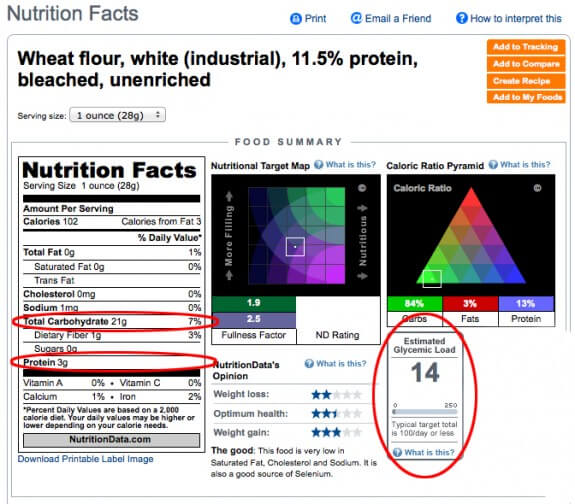
Those who addressed my mistake, also helped me crystallize my point, which is that grains are not a nutrient dense food when compared to meat, nuts and vegetables. I don’t eat grains. I’ve been entirely grain free since 2001.
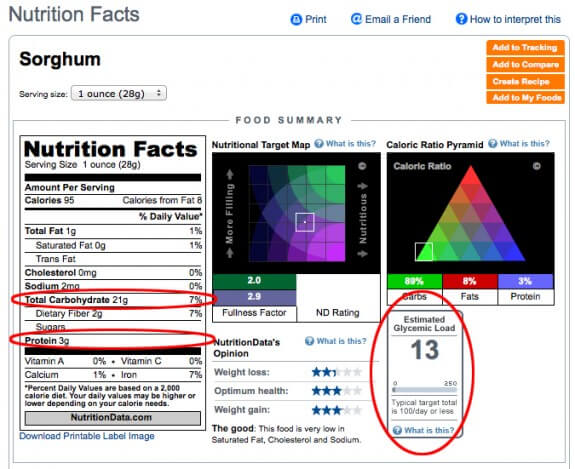
Sorghum flour and wheat flour have a similar protein to carbohydrate ratio of 1:7. Sorghum flour is actually the winner when it comes to glycemic load.
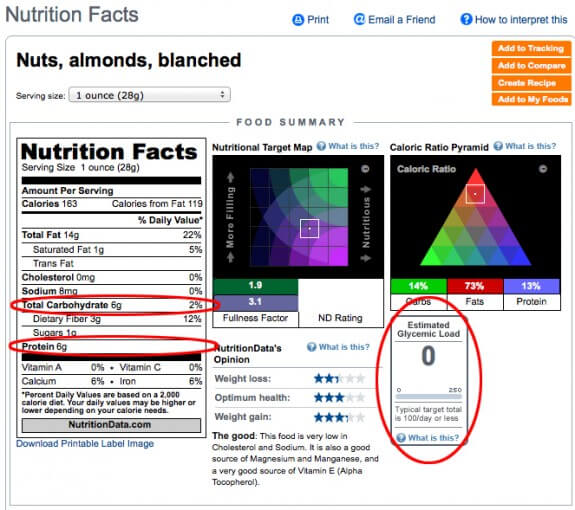
However, take a peek at the table below. As you can see, almonds have a protein to carbohydrate ratio of 1:1 and a glycemic load of 0. Far superior to both wheat and sorghum.
There are many ways to look at nutrients. Addressing nutrition from the perspective of a carbohydrate to protein ratio is merely one very simplistic and myopic way. However, as someone with celiac, this type of analysis is critical because celiac and diabetes ride on the same gene. For this reason, I make a point of controlling my carbohydrate intake and making sure that any carbs I eat are slowed down by either protein or good fats.
To make things even more complex, let’s consider the protein to carbohydrate ratio of broccoli. It is 1:2, not as good as almond flour, yet far better than grains. However, I’ll take my broccoli over almonds any day. And then there are folks who can’t eat raw broccoli because of thyroid issues. But that’s a topic for another post entirely. I think you get the idea. Nutrition is complex.
My point? I wrote the post Gluten Free is Not Healthy to illustrate that fads can’t automatically make certain unhealthy foods healthy again, and that junk food is still junk even if it’s gluten free. I stand by that idea.
Finally, I want to thank you for your delightful comments, whether they agreed with my point or took it to task.
I am grateful for the respectful tone in which so many criticisms were made. The point of this blog is to provide information and conduct a positive and lively dialogue –that is the type of discusion that I will continue to encourage, and with which I will continue to directly engage on both Twitter and Facebook.


Tabitha says
Wow, Debbie. I thought I was fine until my third baby was born (at the time, my age 34), too. I had an allergic reaction to some part of the epidural process (my 1st and last epidural) and thought I must’ve gotten a bad flu bug at the hospital. A few months after the baby, I learned I couldn’t process gluten anymore (or maybe it was always a problem). Then had issues a few months layers with all grains and pseudocereals. Elana’s site saved me from living on Larabars, proteins, fruits and veggies. She provided a way to eat well without digestive distress. I also met some other grain free bloggers through her. Elana, you are right. It’s still junk food even if it is gluten free. The path to healing points to eating foods closer to their natural states; the opposite of swapping gluten filled processed food for gluten free processed food. I can feel my blood circulation change when I have “safe” grains. It was bad enough giving up gluten, but I flat out panicked when I learned the other grains were problematic for me, too. Elana was the biggest encouragement for me and my grain-intolerant baby. Thank you, Elana.
Lindsay says
I found your site when I was at my wits end. I had given birth to my second baby and found out I had post partum thyroiditis because of having undiagnosed Hashimoto’s. I was trying to cut everything out so that I would feel better, because I was feeling awful, and it wasn’t easy. I never knew things like almond flour and coconut flour existed until I discovered your site! I never knew how much I could love to bake! I’ve been grain free ever since and feel so much better. I love baking and my family loves the recipes I’m always trying out. You and your site have been an inspiration to me as well! I will continue to use almond flour. I’m not planning on eating a dozen cookies or muffins a day so I don’t see a problem with it. Thanks for all of your hard work and great recipes!!
Christina says
Thank you for your information. Nutrition/diet certainly IS confusing. There are so many differing opinions that exist, especially for those of us with autoimmune issues. Choices are cegan, raw vegan, paleo, etc. Meta, no meta. Carbs, no carbs. Someone with IBS should eat soluble fiber (including grains) to help with IBS symptoms of diarrhea and constipation (according to help for ibs.com). I am SO confused. All I know is that I have gotten to where even eating food “scares me as I wonder if it is contributing to my fibro/ Hashimoto’s, pain, etc. And, not knowing what to eat. I just read today it is ok to eat chicken, pork, etc. (chinese medicine) if a person is too yang (heat in body) , but not beef. In the blood type diet chicken for type B is a no-no. So, again, what the heck does one eat? And for me, I am looking for health AND trying to gain healthy weight. (I dropped 100 pounds, not on purpose in 10 months). Anyway…everyone has an opinion. And, it is making me nuts. Speaking of nuts…. which I LOVE – no nuts for someone with autoimmune illness? Oh brother!
trudy vanoosten says
Hi Elana…. I really enjoy your blog and will continue to view it. I have ordered your books and look forward to getting them.
I have a question about gluten free….Is wheat grass powder or barley powder consistered gluten free???
I look forward to your answer… either direct or through your blog.
thank you
Rita says
You hit the nail on the head with this one statement…”junk food is still junk even if it’s gluten free”!
Nenah Sylver says
I find the glycemic index only minimally useful. Below are four paragraphs from my book, The Rife Handbook of Frequency Therapy and Holistic Health.
—begin quote—
The glycemic index, invented in 1981 by two researchers at the University of Toronto in Canada, presumably addresses this very issue. The index classifies high carbohydrate foods according to how fast they raise glucose and insulin levels in the blood. Foods that raise blood glucose levels quickly have a high glycemic value, and are considered unsuitable for blood sugar control. Foods that raise blood glucose levels slowly have a low glycemic score, and are considered desirable for blood sugar control. At the very low end of the scale are animal proteins, which contain virtually no carbs. Non-starchy vegetables such as broccoli, leafy greens and zucchini are also low-carb. As one might expect, grains, beans, fruits, and root vegetables (like potatoes and carrots) load the system with easily absorbed sugars, as do concentrated sweeteners.
The problem is, the glycemic index system is abused. First, different databases give radically different advice as to what’s low carb/low glycemic. According to the Official Website of the Glycemic Index and Database (note the authoritative tone implied by the word “official”),
“High is 70 and above; medium is 56 to 69; low is 55 and under.” Not surprisingly, we are encouraged to enjoy grains and noodles. Another website encourages the drinking of wine and beer–even though alcohol is a very rapidly metabolized carbohydrate (which is why people are supposed to drink slowly). Since grains and liquor score high on the glycemic index, one way to make them more acceptable is to raise the baseline for a low score. But reassigning starchy foods to the more desirable “low GI” category does not fool the body into
assimilating them differently. For many people, foods in even the 30 to 50 range can produce insulin and blood sugar spikes. This is why the more sedate Harvard School of Public Health database states: “In general, a glycemic load of 20 or more is high, 11 to 19 is medium, and 10 or under is low.” If you liked to eat carbs, which database
would you prefer using?
Another problem with the glycemic index is its lack of precision. Numerous studies show that blood glucose levels from a food can vary, depending on how the food is cooked or prepared, whether it’s eaten mashed or whole, and whether the targeted food is consumed with fats and proteins (which reduce the GI of the targeted food). These are too many variables for the GI to be of much use!
Moreover, most people don’t realize that controlling blood sugar via insulin levels is only one aspect of managing weight. Another aspect is reactivity to specific foods. Elsewhere in this chapter I discuss the systemic damage that grains and fruit can cause in sensitive people. In light of this information, one must wonder: whose interests are these glycemic index databases serving?
—end quote—
Just something to think about….
Deborah Penner says
Thank you again!!! You’ve inspired me to full on do it and eliminate grains.
Debbie says
I think you’re fantastic and appreciate all your hard work and research into keeping me healthy! I have been able to eat whatever I want and have never had an issue until my late thirties. Suddenly with a the birth of my second son I could not recover. After 2 1/2 years of various doctors making me feel like I was crazy and wanting me to take pill after pill, I found one who spent a lot of time getting to the bottom of it. Being told in one day that you have to completely change your way of life was overwhelming and for a second I thought being sick would be easier! If not for your blog and cook books, and your references to the Spunky Coconut I would still be starving to not be sick! I know it’s hard to have a blog and try all the new recipes, but I REALLY apprecaite it!
Erin says
I’ve never been a big carbs fan, and find the highly-processed gluten-free flours mainly empty calories. Only on the rare occasion will I use GF-free flour mixes instead of almond flour, such as when baking a once-a-year special cake that requires the lightness cake flour can give.
After all, one of the reasons old European traditions involve fruitcakes and sweets as holiday gifts is because refined sugars and flours were expensive and hard to come by. Such ingredients were never staples.
Give me almond and coconut flour, veggies and proteins, any day :)
cheryl says
Elana,
You are a wonderful inspiration and all-round fantastic gal!
Celiac genes track with type 1 diabetes. Not type 2. While we’re not sure what causes Type 1, it’s not obesity related, like 80+% of type 2 is. There are some thoughts that type 2 may be related to an infection and some suspect wheat may be somewhat of a trigger, but largely, we don’t know what causes it. It isn’t related to the amount of sugar consume, glycemic index or the like.
This may sound like nitpicking, and that’s not my intent. The only reason it’s significant is that you reach such a broad audience. I do see type 2 diabetics going gluten-free essentially as a fad to help with their diabetes, and generally it backfires, as you pointed out in your last post.
Thanks again.
Paige, RD CDE in training says
I agree with Cheryl, time for another facts correction if we may.
Stating that diabetes is linked with celiac is too broad a statement. There are many many types and reasons for diabetes. Type , Type 2, type 1.5, MODY, LADA, Gestational onset,and more…. People hear the word “Diabetes” and think of overweight or the elderly without knowing that more than likely they are picturing Type 2 in their heads. Type 2 ( 95% of Diabetes cases are this type) is usually a result of genetic predisposition and nutritional neglect. but not all overweight people are diabetic and many type two diabetics have never been overweight.
Type 1 is autoimmune just like Celiac,lupus, ms, rheumatoid arthritis, some thyroid disorders, etc. Autoimmune is just unfortunate bad luck for most.( possibly strep throat gone wrong, environmental factors, we still don’t know what causes it) for some it’s a strong genetic link too.
But if you have the antibodies that are shutting down your insulin producing cells in your pancreas, there is no amount of low glycemic foods you can eat to stop that process. Antibodies don’t care about your blood glucose level and are not triggered into action by it.
Many autoimmune diseases do “cluster” that is why, as elana stated, you see so many type 1 diabetics with celiac.( My son was diagnosed with both at the age of 3) but since we don’t know what causes it,then we can’t prevent it.
So yes, eat low glycemic foods, stay active, stay healthy, don’t carry around more fat than is good for you and you will be on your way to preventing type 2 diabetes :)
Johan says
I find it interesting, since in my family celiac and diabetes (type 2+ and 1-) are almost epidemic and many are suffering from both regardless of being type 1 or 2… so yes, I think it is very possible that there is a genetic relation between both hereditary health problems…
Elana says
Johan, from what I know celiac disease and diabetes ride on the same gene.