

Did you know that recipes are not copyrightable? It is very challenging to copyright a recipe. That said, I have found that 99.99% of food bloggers and others in the industry give credit where it is due. On that note, I especially enjoy Lillian’s interpretation of my recipes via video on her site Lillian’s Test Kitchen. And kudos go to all the other bloggers out there doing what Lillian does day in and day out.
Unfortunately, sometimes things can go awry when it comes to recipe usage. And here’s an example of that. A couple of months ago, I received a comment from one of my readers regarding a recipe for gluten free pancakes on my website.
Oh, one odd thing… I used a brand of almond flour that I found at a local health food store called Dowd & Rogers and they had the exact same pancake recipe printed on the back of the bag. The only difference is that they said to mix in a blender (instead of saying the Vitamix brand). Not sure if it means anything but thought Elana may want to know…
That was a message from katie h, one of my readers, and I didn’t take it too seriously. However, weeks later, when I compared the two recipes I could see right away what she was talking about.
2 large eggs
¼ cup agave
1 tablespoon vanilla
½ cup water
1 ½ cups almond flour
½ teaspoon salt
½ teaspoon baking soda
grapeseed oil for sautéing
- In a vitamix, combine eggs, agave, vanilla and water and blend on high until smooth
- Add almond flour, salt and baking soda and blend again to incorporate dry ingredients into batter
- Warm grapeseed oil in a large skillet over medium heat
- Pour pancake batter onto skillet
- Pancakes will form little bubbles, when bubbles open, flip pancakes over and cook other side
- Remove from heat to a plate
- Repeat process with remaining batter, adding more oil to skillet as needed
* The funniest part of all this is that this isn’t my best pancake recipe
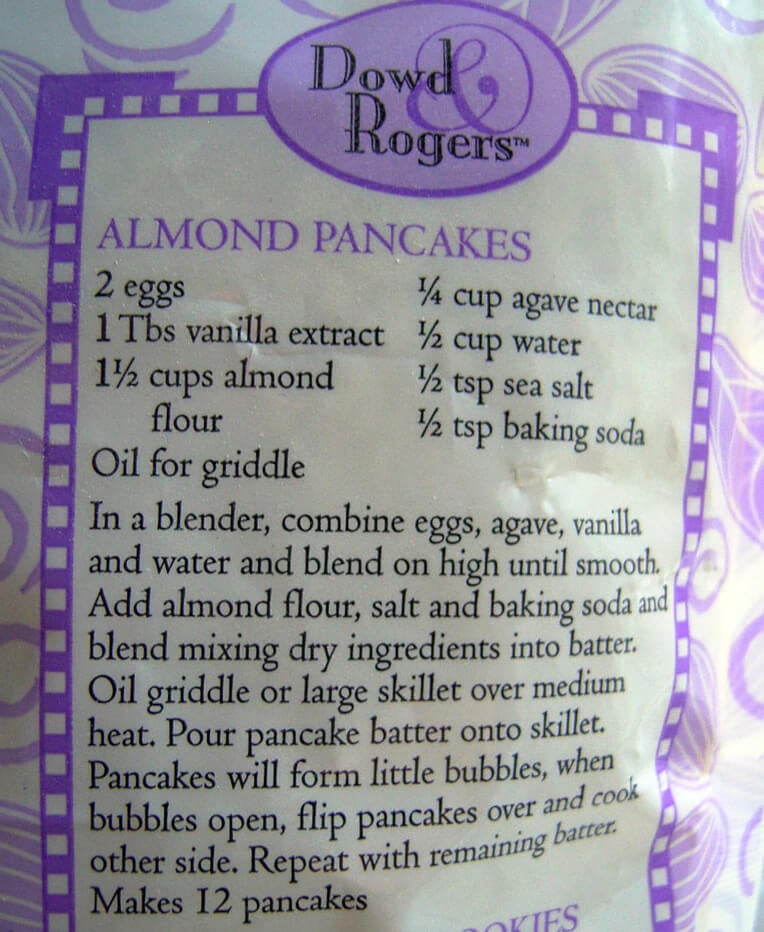
So, I contacted the parent company, the Neutraceutical Corporation of Dowd & Rogers and this is what I was told:
The law regarding copyrightability of food recipes is very clear: recipes are not copyrightable… In short, your letter alleging copyright protection in a recipe is completely meritless.
This legalese seems to be saying that Dowd & Rogers and their parent company the Neutraceutical Corporation can use as many of my (and your) recipes as they like to sell their products. And that they do not need to give any of us credit.
I have more than 350 recipes on this site and after receiving a letter such as the above start to wonder which one Dowd & Rogers will help themselves to next.
I’m not a lawyer, however, something seems amiss here. Wonder if any of you have run into this as well.


mccool says
Really? It’s a PANCAKE recipe. They’re all basically the same. I have a recipe that is the exact same (save for regular flour instead of almond). It’s hilarious that you’d think a corporation stole your recipe.
Téo says
Hi Elana,
Copyright is not the only way to protect your work. It is, and should be, quite a narrowly defined legal protection that only applies to certain kinds of works / products of labour. However, just because something you created (ie. a product of your labour)–like a recipe–is not copyrightable does not mean that anyone can pick it up and use it to their commercial ends. There is a whole body of tort law related to unfair business practices. Someone using something of yours for their commercial ends, especially if it negatively affects your ability to use it for your ends, is definitely the sort of situation this area of the law aims to rectify.
That’s not to say that there’s necessarily something here, but their letter deeming your claim ‘meritless’ is definitely an extremely narrow reading of the situation (and, it sounds like, classic legal bullying).
Best of luck,
Téo
PS. Love your site. It’s the first thing I turn to when I have a few minutes in front of my computer.
Kelly Michelle says
wow a very rude response. I have often wondered about this due simply to the vast number of recipes that exist in books, magazines, the blog world, recipe databases, etc. While an obvious copy and paste is clearly unacceptable I wonder how you draw the line? Often popular recipes exist in a trillion and one almost identical forms and many get passed and tweaked so many times that who knows who actually started it! Not to mention the many times that I’ve thought I had a brilliant idea, created it, and then later come across something insanely similar. It’s a tough field to navigate but clearly to knowingly take a recipe is not give credit is inexcusable.
julo says
I never knew recipes weren’t copyrightable. Crazy! I always thought it was strange that so many bloggers post recipes from cook books without getting in trouble. I guess that’s why?
I guess all you can do is what you just did, alert your readers to what you see, and we can decide for ourselves that we don’t want to support a company that steals! I certainly won’t.
I try to be vigilant in giving credit where credit is due. On my blog I always link to the original recipe I’ve used, rather than posting it on my blog, since it’s not mine. If I alter it, I give credit to the original (including the link) and then post my version on my site. And I always re-write the instructions so they are in my words.
There may not be laws protecting food blogs, but we can always strive to create our own good etiquette that is generally followed. :)
Stacey says
That may be legal (ish) but it certainly doesn’t sound ethical. For the record, I share your recipes with other people but always put a link back to where I found it, even if I modified it to make it SCD. Shame on them.
Lauren @ Healthy Delicious says
It’s always been my understanding that the ingredient list isn’t copyright-able, but the direction are. They clearly stole your descriptions. I would contact a lawyer.
Estelle says
Very rude indeed, “meritless.” These people have never heard of common courtesy. Recipes might not be copyrightable but YOUR text. We are not talking of using same ingredients then use your own words to re-write recipes, we are talking copying and pasting content! YUCK. Good thing I buy my almond flour from Honeyville, won’t give these people a penny.
carolyn says
That’s disappointing. I could see maybe there would be no merit if the creator of the recipe did not have a book. I think of it along the same lines as getting a recipe that’s passed down from a friend. But surely since you are published there is something that you can do about it. I hope that you can.
SassaFrass88 says
Yes, being a blogger myself, I like to give credit where credit is due, even though, they are correct, you cannot copyright things like ‘code’ or individual ingredients in a recipe, but that doesn’t mean that someone won’t notice and then fighting for your credibility comes into play.
Call it Karma, call it God’s vengeance, but I believe that they’ll get theirs in the end if people see enough of it.
Now, once your book is published, can that be another thing altogether?
Maybe you should ask your editor….
Christie {Honoring Health} says
I wish I knew what to say other than I am sorry this has happened. I always do my best to give credit where credit is due and think the response from the company was mighty rude.