
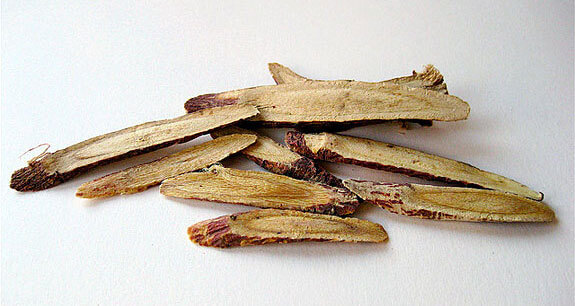
It seems like everyone I know had a sore throat last week. So I made a big pot of my favorite healing brew, Ginger Licorice Tea.
As I often do, I went on twitter, this time to chat about my fave tea for colds and sore throats. While everyone was familiar with ginger, several folks told me they hadn’t ever heard of licorice root. So here we go, I’ll tell you all about licorice root and why it’s absolutely indispensable in my home this time of year.
In the world of herbs, licorice root is primarily known as a demulcent (that is a soothing substance taken internally to protect damaged or inflamed tissue) and an expectorant (a substance that assists in expelling mucus from lungs and throat). Licorice root is commonly used in alternative medicine to treat colds and sore throats. However, licorice does not only act upon the respiratory system. It can also be soothing to the gut and work as an effective liver cleanser and blood detoxifier when combined with other herbs.
- soothes a sore throat
- loosens bronchial congestion
- reduces inflammation
- soothes digestive and gastro-intestinal issues
- helpful with stomach ulcers
Licorice is also used for chronic conditions such as adrenal insufficiency. However, used in large doses, over long term, licorice can exacerbate hypertension, so it is best to see a doctor or herbalist if you are going to use this substance for chronic conditions.
Although my background is in Ayurvedic herbology, I do have some knowledge of Chinese herbs, and licorice is used often in Chinese medicine, considered one of the most important herbs in that system. Licorice is also commonly used in Ayurveda as well, as it is very soothing for the vata dosha (constitution).
Licorice basically helps people that are experiencing ailments of “dryness” in the body become more moist. I tell my children that when you have a cold, taking licorice is like putting a humidifier in your body –that’s how it works. For this reason, licorice is not the best herb of choice for those that tend to retain water in their body –those that we refer to in Ayruveda as having the kapha dosha.
With licorice and other roots, I was taught that it is best that they boil in water for 2-3 minutes minimum to release all of their healing properties. While licorice tea is available (in tea bags) in many health food stores, to get the full benefit of the licorice root, I would recommend purchasing in bulk
I kept a pot of Ginger Licorice Tea steeping on the stove every day last week as we had severe, harsh weather here in Colorado. Every humidifier in my house was on. Some days the temperature didn’t even make it above 5 degrees. Drinking this simple herbal remedy was very moistening for myself and my family given this cold, dry tundra we’re living in this winter.
So, finally, just to be clear, when I’m talking about licorice root, I am not referring to licorice candy. This is a totally different thing made of molasses, flour and other ingredients. Let’s not confuse the pure healing licorice root with licorice candy.
Have you ever used licorice root? If so, what ailments do you use it for? Leave a comment and let us all know!




Melinda says
I make a detox tea also with licorice root and many other herbs. I am going to try this one right now….
Jenny Eliuk @ Stay on Path says
I just started taking G.I. Benefits from FoodScience of Vermont, and licorice root is a main ingredient. I didn’t realize it had that “internal moisturizing” effect, however. Thank you for this info.
Karen@Cook4Seasons says
Incredible timing! Not because I’m sick (knock on wood) but because I have just started an Ayurvedic program and am all over licorice and ginger (double dosha – pitta/vata.) It has taken me awhile to acquire the taste for licorice but with ginger I am enjoying it. And I love that you noted the health benefits! Would love to share notes about this new way of eating/drinking:)
linda says
Can you get too much Licorice root.
Eve Ilsen says
I’ll try it!
This past week we all had colds, so I brewed up The Elixir (previously known as The Vile Australian Concoction, originally given to me when we arrived to teach in Australia and I was coughing up green.)
In about two quarts of water, cut up a whole large handful of fresh ginger root; throw in at least ten cloves of garlic, unpeeled. Simmer for at least 15 minutes. Strain out the solids.
Ad honey to taste (organic and raw is good; manuka even better, but very expensive) and about a quarter cup apple cider vinegar.
Drink hot and go “YICCCHHH!”
Then get better.
Kathryn Richards says
Hehe! Love your description!
Pat says
I know licorice is good for you, but it’s not my favorite taste.
Ginger, however, is. A good healing food this time of the year is to cook buckwheat in chicken stock with ginger slices, chopped carrots and onions, and salt to taste. It’s very warming and really satisfying if you are coming down with something. Some licorice would be a good addition.
Pat
Brandon says
I’ve recently been getting back to my roots of natural herbal healing these days. Since I was twelve I have studied different healing remedies, yet moved into the whole foods approach to healing. Only recently have I started back on herbal and plant healing, and I love it! Thank you for sharing this article Elana. Purchasing some licorice root very soon for those “just-in-case” times.
Anne Fischer Silva says
I use licorice root with sassafras and whey to make a delicious natural root beer. Licorice can increase blood pressure so those with hypertension should use caution.
Melissa says
I haven’t used licorice root before, but this sounds great. Since going gluten free I have missed licorice candy. Any chance you could create a gluten free licorice candy?
Mary says
trader joes has a gluten free licorice called scottie dogs.
john says
Awesome! thank you!
Melissa solar-greene says
Another possibility for creating licorice candy is to powder the root and combine it with heated honey. Drop them in dots on some parchment and let them cool. You will have licorice honey yum drops. Plus the honey is also demulcent and soothing. : )
jessie zander says
What a fantastic idea instant throat soothers
Ashley @ Taste for Healthy says
I’ve used licorice root tea for stomach issues… and it seems to work very well!
P.S. I did not know that it is especially beneficial for the vata dosha… thank you for enlightening me! :)
Yaelian says
I have ground the liquorice root into powder and added it into my green smoothies. And as a Finn,I love liquorice in every way….
Diana says
my naturopath suggested using licorice to help heal my gut from gluten intolerance and to help decrease the inflammation
Jackie says
Licorice is great for that, but look for a combo of deglyccerized licorice (no blood pressure effects), aloe and L-glutamine. That’s the gold standard for GI tract healing. I use it with patients all the time.
Patti Krueger says
Where do you find deglyccerized licorice? Is that the kind they use in the licorice tea that Yogi or Traditional Medicines makes?
Patti
Melissa solar-greene says
DGL is avialable at health food stores or places like Pharmaca. They usually come in chewable tablets. The Gliceriza constituent has been removed because it has been shown to cause hypertension in large doses over long periods of time. If you are using it to heal the mucous membranes in the upper GI you will probably be using it in significant quantity and over a longish period of time.
PS – It has been shown to protect liver cells and shortens the half life of cortico-steroids in the body. That means less work for the adrenals.
Dave Brown says
Please more specific about the healing of the GI tract, and how to apply or ingest the concoction. Thank you I am Dave Brown
dave@montanainternet.net