
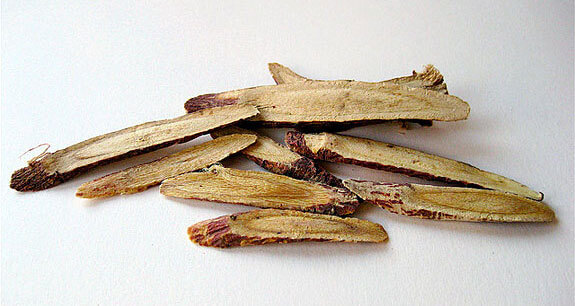
It seems like everyone I know had a sore throat last week. So I made a big pot of my favorite healing brew, Ginger Licorice Tea.
As I often do, I went on twitter, this time to chat about my fave tea for colds and sore throats. While everyone was familiar with ginger, several folks told me they hadn’t ever heard of licorice root. So here we go, I’ll tell you all about licorice root and why it’s absolutely indispensable in my home this time of year.
In the world of herbs, licorice root is primarily known as a demulcent (that is a soothing substance taken internally to protect damaged or inflamed tissue) and an expectorant (a substance that assists in expelling mucus from lungs and throat). Licorice root is commonly used in alternative medicine to treat colds and sore throats. However, licorice does not only act upon the respiratory system. It can also be soothing to the gut and work as an effective liver cleanser and blood detoxifier when combined with other herbs.
- soothes a sore throat
- loosens bronchial congestion
- reduces inflammation
- soothes digestive and gastro-intestinal issues
- helpful with stomach ulcers
Licorice is also used for chronic conditions such as adrenal insufficiency. However, used in large doses, over long term, licorice can exacerbate hypertension, so it is best to see a doctor or herbalist if you are going to use this substance for chronic conditions.
Although my background is in Ayurvedic herbology, I do have some knowledge of Chinese herbs, and licorice is used often in Chinese medicine, considered one of the most important herbs in that system. Licorice is also commonly used in Ayurveda as well, as it is very soothing for the vata dosha (constitution).
Licorice basically helps people that are experiencing ailments of “dryness” in the body become more moist. I tell my children that when you have a cold, taking licorice is like putting a humidifier in your body –that’s how it works. For this reason, licorice is not the best herb of choice for those that tend to retain water in their body –those that we refer to in Ayruveda as having the kapha dosha.
With licorice and other roots, I was taught that it is best that they boil in water for 2-3 minutes minimum to release all of their healing properties. While licorice tea is available (in tea bags) in many health food stores, to get the full benefit of the licorice root, I would recommend purchasing in bulk
I kept a pot of Ginger Licorice Tea steeping on the stove every day last week as we had severe, harsh weather here in Colorado. Every humidifier in my house was on. Some days the temperature didn’t even make it above 5 degrees. Drinking this simple herbal remedy was very moistening for myself and my family given this cold, dry tundra we’re living in this winter.
So, finally, just to be clear, when I’m talking about licorice root, I am not referring to licorice candy. This is a totally different thing made of molasses, flour and other ingredients. Let’s not confuse the pure healing licorice root with licorice candy.
Have you ever used licorice root? If so, what ailments do you use it for? Leave a comment and let us all know!




jodie says
I am and acupuncturist and you are absolutely right licorice is used so much in Chinese Medicine. I love it for sore throats.
If anyone is a little intimidated by the raw herb, Yogi Tea brand makes some lovely licorice teas. I carry bags in my purse all winter long, and it is so sweet that my daughter loves it too!
Chris says
Not to forget that Liquorice root is also great for adrenal health and regulating cortisol production (which many of us struggle with now days) I love liquorice root tea in the afternoon, really clears the head and lifts the spirits. I have been told by people it has also helped with their sugar cravings when taken at night…..
Heather says
We use licorice root for acid reflux, usually. Good to know it works for sore throat, too!
Kedesh says
Thanks, Alana! This was very educational. Licorice root is now on my shopping list. YUM! x
Ruth says
I’ve recently discovered licorice root which I am taking for adrenal fatigue. I’ve always loved licorice but can no longer eat it due gluten & sugar intolerance. At present I am taking it in capsule form as well as drinking it in a tea which also contains fennel seeds, peppermint leaves & aniseed.
Georgia Pellegrini says
The healing properties of licorice root are fascinating. Thanks for the post
Lisa @ www.bakedinmaine.com says
FABULOUS!!!!
I’ve taken the Licorice capsules for a severe stomach upset. There is a more expensive version that you can buy that doesn’t raise the blood prssure.
I can’t wait to make my own tea!!!
Thanks!
Lisa
xox
The Newlywed Chefs says
Never used it- but how cool! We’ll have to try it soon.
Meggs Hannes-Paterson says
Just a quick note. Be cautious with Liquorice. A friend of mine doing a detox program decided that he would drink liquorice tea as his substitute for coffee & alcohol. He ended up in hospital with a racing heartbeat. They put him on medication to slow it down. It was recommended that you don’t drink it with such gusto as he did! A cup or two a day rather than many cups. Cheerio, Meggs
Christy says
I also use licorice root for sore throats. It works better and longer than chloroseptic spray any day!