
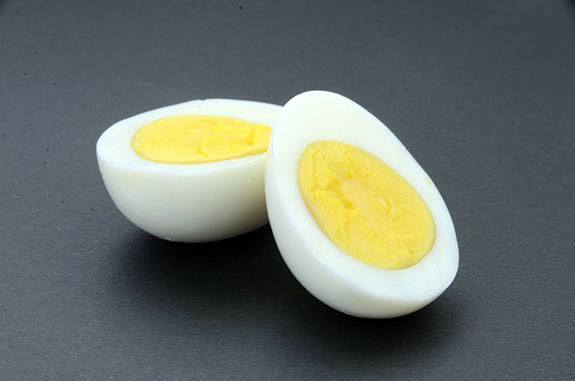
My boys love hard boiled eggs, and so do I. Since eggs are a healthy, high-protein, real food snack we’re in luck. I’ve been teaching my boys basic cooking skills since they were in kindergarten. I think knowing how to boil eggs, i.e., how to make a hard boiled egg, or a soft boiled egg (same thing, less time), is a basic kitchen skill that is important to have. Although the boys have been preparing scrambled eggs perfectly for over a decade, I had not yet transmitted a superior process to them for making hard boiled eggs.
After much trial and tribulation, with dozens of batches of eggs, over several weeks, I can assure you that this tutorial will teach you how to make the perfect hard boiled egg. And now my boys have this knowledge as well.
How to Boil Eggs
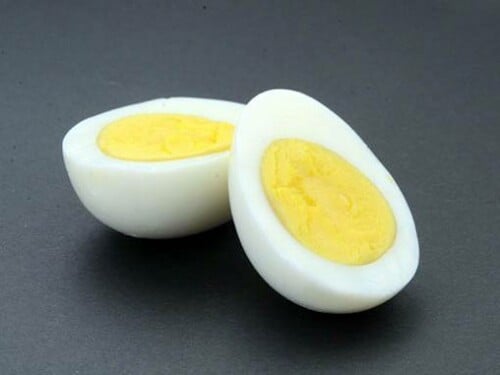
Ingredients
Instructions
- Use a medium sized pot (I use this 4 quart pan )
- Add 3 inches of water to the pot and bring to a boil
- Gently lower eggs into boiling water with a spoon
- Reduce heat to medium, so that water is simmering
- Cook for 15 minutes for hard boiled eggs
- Remove eggs from water with a spoon, allow to cool on a plate for 5-10 minutes
- Crack shells on counter and peel eggs
Equipment
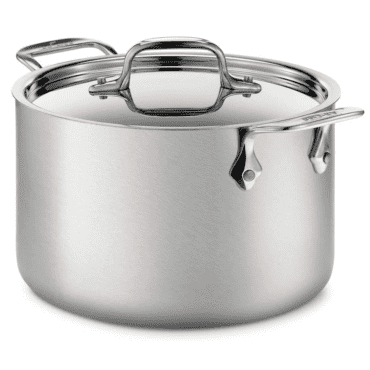
The first method I tried was to place the eggs in the pot, add water, and then together bring the eggs and water to a boil, letting them simmer for the cooking time. Using this method, the cooking times were not very consistent or reliable, and the eggs were extremely difficult to get out of their shells. I also experimented with bringing the eggs to a boil in the water and then turning off the heat to allow the eggs to cook. Again, cooking times had too much variation and the eggs were quite a challenge to peel. There were other experiments too, though I won’t go into each and every one. Suffice it to say that the method I landed on, i.e., bringing the water to a boil, adding the eggs to the pot, then simmering the eggs for 15 minutes, is a sure winner.
One other piece of the “how to boil eggs” puzzle that I studied is how to get the eggs in and out of the water. Many recipes for hard boiled eggs recommend using a slotted spoon for this. Truth be told, I don’t own a slotted spoon. I use a regular ol’ large spoon from my flatware set to get the eggs in and out of the hot water.
The next piece of the puzzle was finding the easiest way to remove the eggs from their shells. So, what is the best way to peel a hard boiled egg? Contrary to my initial thoughts, the winning method did not involve a cold water bath. Simply removing the eggs from the boiling water, and setting them on a plate to cool for five to ten minutes was the most fool proof method. This cooling time is literally to allow the eggs to come to a temperature where you can safely handle them without scorching your hands.
Just in case you have other ideas for ways in which to cook eggs, I have compiled the handy dandy chart below. You can make everything from three minute eggs (serve in a cup, eat with a spoon) to hard boiled eggs, and then some in between.
Finally, make sure to set a timer when you make hard boiled eggs so that you do not overcook them! When that happens, the yolk gets a nasty greenish grey ring around its outside, and the white becomes rubbery. No bueno. The best way to prevent over cooking your hard boiled eggs is to watch the timer, and remove the eggs from the hot water as soon as it goes off.
So now you know how to boil eggs! Hard boiled, soft boiled, there you go! What will you do with your hard boiled eggs? If you’re looking for deviled egg recipes, try my Deviled Eggs, and stay tuned next week for my Guacamole Deviled Eggs! The boys are big fans of both and regularly devour batches after school.




damselflydiary says
There is a video out that shows you how to peel an egg in seconds, perfectly. Google: how to peel an egg in seconds. I saw it on the news a month or so ago. I haven’t tried it yet.
I was having problems peeling eggs until I figured out that if you put them in water and let it come to a boil they won’t peel. You have to put cold eggs in boiling water.
Also, Elana, I know you are at elevation so I wonder if cook times might be less than 15 minutes closer to sea level.
Funny how much commentary there is about something as simple as eggs!
heidi says
Actually, I recently tried a new approach to HB eggs and it’s head and shoulders above any water method. Bake eggs in a 325 degree oven (ideally in a silicone muffin pan* with NO water in the cups) for 30-35 minutes. Then straight into an ice bath and voila, perfectly done, smooth and creamy yolks with no green edges. My hubby said he had amazing eggs for breakfast in Greece 25 years ago and when he tasted these HB (hard-baked) eggs he said “Yes, these are the eggs!” (*We only have a silicone bunt pan so I lay 8 eggs in the 8 grooves and they turn out perfect.)
Lara Pizzorno says
The longer eggs are exposed to high heat, the more damage will be caused to the healthful omega-3 fatty acids eggs will contain (if free range, organic). Your eggs will be perfectly hard boiled if you place them in a medium-sized pot (All Clad is great), cover with water (room temp is fine), bring to a boil and then let boil for just 3 minutes. Then turn off the heat, cover the pot and let the eggs sit in the hot water bath for 10-15 minutes. They will still be cooking, but not at such a high, and fatty acid-damaging, temperature. Drain off the water, transfer the eggs to a bowl and put them in the refrigerator until completely cooled and well chilled. This will cause the egg to shrink away from the shell for easy peeling. Tap the large end of the egg to crack the shell and begin peeling. If any of the interior membrane (which is immediately inside the egg shell and should be sticking to it rather than your egg) is still attached to the egg, run the egg under cool water while peeling to loosen the membrane and gently slide it off the area in which it is sticking.
Patty says
This is the same way I boil eggs, it always works great. I don’t peel my eggs until I need them. They always peel easy when their warm. I like to use them as I need them.
Sharon Slocum says
I have had the worst time peeling eggs lately and can’t wait to try these tips. I usually put them into cold water with one of those “timer eggs’ that tells you when the eggs are ready but maybe it is getting worn out, as I have been getting dark rings around the yolks, which I always thought happened when using a pot made from aluminum. Thank you Elana.
Liz Dick says
Put you cooled hard boiled egg in a mason jar, close the lid and shake it up. It peels really easy.
Beth says
This really is the ultimate way to peel the eggs no mater what temp they are at or how long it has been since they were cooked! I also add a small amount of water to the jar. There is a bit of a learning curve with how hard/long to shake the egg in the canning jar (totally destroyed the first one I ever attempted) but you catch on quick! Absolutely my favorite way to peel eggs!
Jules says
I use to have a hard time peeling farm fresh eggs. Tried the baking soda, it worked okay. Then I started boiling the water first. Resolved everything. No longer had to add anything and cook time is consistent. 11 minutes will give you a nice hard boiled egg with a yoke that is moist and slightly darker in color toward the center. Once in a while an egg will crack due to the temperature change, but that’s not a deal-breaker for me.
Janna says
If your eggs are room temperature they won’t crack. Instead of having them sit on the counter, though, I just let them sit in a bowl of warm water for a couple of minutes.
Anne Kahlbaugh says
I really appreciate this post as we use fresh organic eggs from a local farmer and uses non-GMO feed to supplement their nutritional needs. Our experience was when the eggs were really fresh, they would not peel well at all–small little shell fragments bit by bit! Thanks for the work Elana in giving us this great tip! I like this schedule of the various times and outcomes and appreciate Elana’s time and effort in figuring all of this out! Kuddos!
P.S. The pin hole pricked in the bottom of an egg does work and even adding a teaspoon of baking soda to the water assisted in an easier way to peel an egg too.
Robyn says
If you use a thumb tack to poke a hole in the large and of the egg before putting the egg into the water, you will have no problem, whatsoever, peeling the egg after the cooling off period.
Laura ~ Raise Your Garden says
I just laughed out loud at this post because of my mishaps with boiling eggs. One of two things seem to happen 1.) I boiling them to death and they come out gross 2.) I don’t go long enough and end up with a runny mess. And peeling the shell is always such a mess for me! Trying this again. Thanks for the tips.
JenniferR says
STEAM your eggs, don’t boil them, for the easiest peeling ever. I tell everyone this but rarely does someone truly believe me or want to try it. A friend with 5 kids, 3 of them triplets, taught me this tricks years ago because she went through 2 dozen eggs a day and had to figure out the easiest method.
Put the eggs in steamer basket over a pot of water and turn the heat to high. Immediately set the time for 16 minutes for creamy hard eggs. When the timer goes off, dump the eggs in cold water and peel. I PROMISE this is the easiest way to peel them.
Teresa says
I learned of steaming eggs and was amazed that even fresh farm eggs peel perfectly. I have even peeled them before the eggs cooled off. Best tip ever!
Beverly says
Yes, steam them. Really, I have tried all kinds of ways and steaming them always works. Fresh farm eggs peel easily every time. Steaming them keeps the eggs at a constant temperature and some other scientific facts.
Kim says
So I have only steamed eggs in an electric egg cooker. I want to try this out and am wondering if you put a lid on the pot and do you turn the heat down?
Sherron says
I don’t know why I never thought about the size of the egg determining the time- I assume that most guidelines are for large eggs and I almost always have extra-large eggs. This might explain why my eggs always seem to be slightly under cooked!
I’m going to try the counter top cooling method this week!