
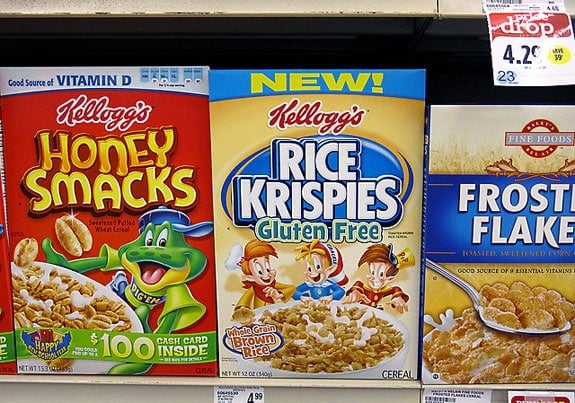
Gluten Free is not healthy? Blasphemy –you must think someone has hijacked my blog, but it’s true. Just because a food is gluten free does not mean it is healthy.
Sadly, the recent popularity of “gluten free” has many thinking that if they eliminate gluten, they are on a healthy diet. As Michael Pollan wrote last year in the New York Times Magazine, “Gluten has become the bad nutrient of the moment.”
I think it’s time for those of us in the gluten free blogoshpere to admit that villainizing one ingredient is not enough when it comes to eating well.
With all of the hype surrounding gluten free, no one mentions the dirty little secret of the Standard Gluten Free Diet. Few realize that when it comes to gluten free baked goods such as bread, snacks, and desserts, gluten free food is not as nutritious as “regular” food. That’s because gluten free goods are generally made with ingredients such as rice, corn, potatoes, sorghum, tapioca and millet, which are higher in carbohydrates and lower in protein and other nutrients than wheat flour. Sad, but true. The typical gluten free ingredients that are used in place of wheat are less nutritious than wheat itself.
The Gluten Free diet is a very specific requirement for very specific people –those with celiac, gluten intolerance or gluten sensitivity. People with these conditions have to eliminate gluten from their diets to make sure their body doesn’t deteriorate. Let’s remember though, that doing so doesn’t actually speak to eating the diet and consuming the foods that allow your body to thrive. Those are two separate things. Therefore, the millions of Americans jumping on the gluten free bandwagon, who believe that eliminating one ingredient is a quick fix are short changing themselves.
If you have any of the above conditions (and it’s a good idea to go to a doctor and get tested if you think you might) remove gluten from your diet. For that matter, if something makes you feel sick, get it out of your diet! However, if you think eliminating one food gives you a free pass to eat processed gluten free goods made from rice, corn, etc., and that this will make you healthy, guess again.
The best path to wellness is a well rounded diet which includes many foods –it is far more work than simply bastardizing one ingredient, such as gluten.
What does eating healthy entail? Consuming a diverse array of nutrient dense foods every day; day after day. When I was a little girl, my Dad told me to eat the rainbow. So I’m staying away from fad diets and sticking with Dad’s advice. I have to agree with him, eating close to the earth is, and always has been, the way to go.


Christine says
Brava to you Elana for being brave enough to share your own personal journey in search of wellness with the rest of us who are also seeking answers and solutions for our own bodies. I learn so much from your blog and adapt so many of your insights and also use so many of your recipes on my own journey. Since learning of the dangers in rice and corn etc., for Celiacs, I especially appreciate learning more and more about eating Paleo/Primal. Thank you for taking precious time from your own wellness program and from spending precious time with your own family, to share with those of us who are also seeking methods back to good health! You are a beacon of light Elana! Hugs x
sandy says
Thank you for your insightful words. I know a few celiac sufferers and have watched them gain weight, lose control over their health simply because they did not look at the whole nutritional picture. I am diabetic and have sought out food options to reduce my carb load, increase my protein and fiber without sacrificing the foods I enjoy. In so doing I started looking onto the celiacs world for flour substitutions.To make such changes in one lifestyle is difficult and convenience seems to be the priority rather than finding the best options for better health. Sadly the idea that one must cook seems to be a great challenge in our society.I understand that when one works full time, have a busy family life that finding time is hard but if ones health is sacrificed what has one gained?
kmorganics says
I am also diabetic and have been for 44 years. I have found some very low carb and healthful foods that are tolerated by diabetics as well as exercise and healthy eating. I carry some of these items in my store and would be happy to discuss what you might be interested in or what I have found to be usefull for myself. Please contact me if you are interested. kmorganics.com
Tammy says
I had my autistic son on a gluten free diet for a year. So I know that a gluten free diet can be restrictive, and that you are losing some important vitamins and minerals when you are eating gluten free. I off-set that by making sure he got fresh vegetables, and supplements.
Amy says
The wheat of today is not the wheat that our parents and grandparents grew up with – it’s a hybridized version of a grain that now contains up to 6 times the amount of gluten it did even 50 -100 years ago. We simply haven’t evolved to eat this “new” wheat, so I think gluten is difficult for a huge segment of our population. But the key is listening to your body. If you’re paying attention, it will tell you nearly everything you need to know. Rewarding yourself with sweet gluten substitutes is a natural progression toward making this life style change, but when the dust settles, find out what works for you – whether it’s almond flour or a GF flour mix or the elimination of most grains…just ask your self how you feel. As for me, the last thing I eat is anything packaged that is labeled as gluten-free. All the gluten substitutes make me feel as bad as gluten. When I decided to deal with the stresses in my life and started listening to my body, it all came together for me…only took 20 years :)
Susan says
Sadly, we are not the real audience for Elana’s message. Most folks who have sought out and regularly read blogs like Elana’s have done so for our own personal health and dietary restrictions or choices, and generally understand the distinction between gluten-free and low-glycemic foods. As Elana pointed out in an earlier post, there is a strong correlation between celiac disease and diabetes, and many people who need to eliminate gluten also need to reduce their carbs and glycemic load. As a result they feel better and lose weight. The general public often does not recognize this “other level” and just assume gluten-free will result in improved health and weight loss. The food manufacturers are taking advantage of this misunderstanding. It is profit.
Yes, there is some controversy about whether high-glycemic foods are healthy or not. The answer is not simply yes or no, it is “it depends.” For a growing number of people the answer is yes. Most commonly this is due to diabetes, but there are many other metabolic or health issues that are relieved by adapting a low-glycemic diet. Often those reasons are related, directly or indirectly, to insulin production.
I don’t have diabetes or celiac disease, but I discovered that my growing problem with irregular heatbeat and palpitations was nearly eliminated when I changed to a low-glycemic diet. Why? No one knows. Doctors just shrug. Regardless of the cause, I seek out recipes that use low-carb, satisfying alternatives so I don’t feel too tempted to eat something that will make me feel terrible. All I know is that something about the triggers for insulin production in my body causes something else to go wrong and results in scary irregularities in my heartbeat. So is a high-glycemic diet the cause of heart disease? Of course I can’t say that, because I’m the only person I’ve ever heard of who gets palpitations due to carbs. But for ME, it is related. Each of you need to accept that your own personal observations and adjustments are not universal. Don’t get upset because someone promotes foods that you don’t find work for your personal diet.
But back to the general public. The fact is, when you understand how the body adjusts to low-glycemic intake, you might understand why some people seem remarkably healthier and even thinner when they change their diets, depsite the increased intake of nuts and oils. It’s all about how your body processes these foods – storage, energy, or elimination? If you eat a lot of carbs, you body’s systems are geared toward storing food as fat. That’s what insulin does. If you don’t eat many carb, and therefore have low levels of insulin in your system, it’s first impulse during digestion is NOT storage. It’s that easy. If you eat carbs and lots of nuts, oils, and high-calorie foods, you will get fat. If you don’t eat many carbs, you body uses those calories differently.
If high-glycemic foods don’t bother you and you have no ill-effects or weight problems, then harrah for you! The rest of us (at least me) will envy your tolerance. Yes envy. I would LOVE to eat a sandwich on chewy, crusy bread, a piece of pizza, or a platter of sushi. When the cravings have been getting too much, I make a batch of muffins or cookies with almond flour. No it isn’t as satisfying, nothing is, but it takes the edge off and that’s what I need to stay healthy.
Whether you are a celiac, diabetic, have general food allergies, or even people like me, who have no idea why they have intolerances to certain foods, then perhaps Elana’s recipes are helpful for adjusting to your new diet. But if you can eat or tolerate foods that she cannot, then don’t blame her for saying those items are not healthy. In general, she is correct. They are not healthy for her, nor for a great many of us. As you get older, they may not be healthy for you either even if the are now. Few sites will be perfectly adapted to our individual needs, but feel free to make adjustments that work for you. Just because she can’t eat beans or quinoa doesn’t mean you cannot. It doesn’t mean she thinks you shouldn’t. Don’t blame the blogger if their needs are not the same as yours. it is your responsibiity to learn and adjust for your own requirments.
Kathryn says
I was amazed at the lack of nourishment I found in gluten free foods – they are so processed! thank goodness someone finally addressed the issue. The husband of a friend of mine was diagnosed with colon cancer. She didn’t understand why he should develop that when he was on a gluten free diet!!! Duh! She hadn’t increased his fiber or anything . . . he was still living on a highly processed diet.
QueenJellyBean says
Thank you for saying this Elana. Great headline. Your recipes have been the antidote for starch-filled “GF” store bought products. I didn’t know how to address the unhealthy standard GF diet. Thank you for sharing your fabulous whole-ingredient, close-to-the-earth recipes. Your site talks the walk. Now … about GF gnocchi – or GF pumpkin gnocchi – just wondering if you’ll even test recipe some gnocchi? It’s the one thing I never see GF, which I’ve been since 2007. Keep up the fabulous work you do. Thank you.
molly says
Even though it may be a “gluten free craze” right now or gluten is the “bad molecule” of the moment, I gotta say I love the awareness it has created and stirred… because, unlike fat and carbs, gluten is actually part of a very real, very hurtful disease. People actually know what gluten is when I tell them I can’t eat it, and even as little as three years ago, people had no clue. There have definitely been positive consequences of the “gluten bad molecule movement.”
Anna says
Sorry but carbs are also part of a “very real, very hurtful disease”. I have it and it is called diabetes.
eden says
Well said!
I read the following rhyme once and it stuck with me:
Just because it’s gluten free
Doesn’t mean it’s good for me
I have celiac disease, so for me gluten is poison. But that doesn’t give me a green light to grab anything labelled “gluten free”… I still have to decide if I’ve worked out enough to indulge in a cookie, or a big pasta dinner… just like anyone else who needs to watch what they eat. Veggies, fruits, lean proteins and whole grains are my friends, just like anyone with “normal” guts.
Michelle says
Thank you. Well said and long overdue.