
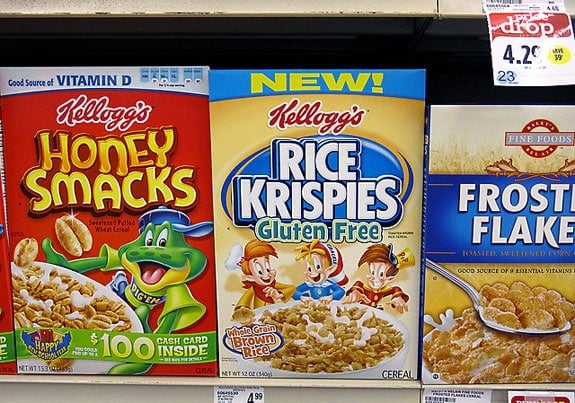
Gluten Free is not healthy? Blasphemy –you must think someone has hijacked my blog, but it’s true. Just because a food is gluten free does not mean it is healthy.
Sadly, the recent popularity of “gluten free” has many thinking that if they eliminate gluten, they are on a healthy diet. As Michael Pollan wrote last year in the New York Times Magazine, “Gluten has become the bad nutrient of the moment.”
I think it’s time for those of us in the gluten free blogoshpere to admit that villainizing one ingredient is not enough when it comes to eating well.
With all of the hype surrounding gluten free, no one mentions the dirty little secret of the Standard Gluten Free Diet. Few realize that when it comes to gluten free baked goods such as bread, snacks, and desserts, gluten free food is not as nutritious as “regular” food. That’s because gluten free goods are generally made with ingredients such as rice, corn, potatoes, sorghum, tapioca and millet, which are higher in carbohydrates and lower in protein and other nutrients than wheat flour. Sad, but true. The typical gluten free ingredients that are used in place of wheat are less nutritious than wheat itself.
The Gluten Free diet is a very specific requirement for very specific people –those with celiac, gluten intolerance or gluten sensitivity. People with these conditions have to eliminate gluten from their diets to make sure their body doesn’t deteriorate. Let’s remember though, that doing so doesn’t actually speak to eating the diet and consuming the foods that allow your body to thrive. Those are two separate things. Therefore, the millions of Americans jumping on the gluten free bandwagon, who believe that eliminating one ingredient is a quick fix are short changing themselves.
If you have any of the above conditions (and it’s a good idea to go to a doctor and get tested if you think you might) remove gluten from your diet. For that matter, if something makes you feel sick, get it out of your diet! However, if you think eliminating one food gives you a free pass to eat processed gluten free goods made from rice, corn, etc., and that this will make you healthy, guess again.
The best path to wellness is a well rounded diet which includes many foods –it is far more work than simply bastardizing one ingredient, such as gluten.
What does eating healthy entail? Consuming a diverse array of nutrient dense foods every day; day after day. When I was a little girl, my Dad told me to eat the rainbow. So I’m staying away from fad diets and sticking with Dad’s advice. I have to agree with him, eating close to the earth is, and always has been, the way to go.


melissa says
I agree!! I see gluten free paraded, but then see other ingredients that are not good for me. I follow the genotype/eat 4 your bloodtype lifestyle and there are so many added ingredients that are not good for me. I love your recipes as they are usually spot on. It’s not a fad, it’s a lifestyle change that makes me feel better….and makes me feel good about myself.
Carol says
Thank you for explaining that it is not just eliminating the bad but replacing it with the good. I developed a wheat allergy – it truly does affect my airway; and is worse if combined with yeasts, mushrooms, molds (cheeses), etc. Because of airway issues, I was advised to stop all gluten and yeast foods by naturopathic, not a medical doctor. Other food allergies and sensitivities triggered asthma symptoms, some severe. As I learned what these foods were, I was encouraged to remove them from my diet. But I was not given any guidance on what I could eat, how I should prepare my food, etc.
It has been a long journey – nearly 7 years with trials and errors and occasional set backs. About a year ago, I read that those of us with sensitivities really need to get back to cooking like our grandmothers did…from the whole food that actually grows in the gardens. That was my first big step forward to the recovery I have been experiencing since. I was also lucky enough to find a certified nutritionist who ordered a different type of blood test for testing allergies, intolerances, and sensitivities to over 96 different foods than the traditional medical allergist who diagnosed my asthma but could not identify any triggers.
For the most part, what has taken me so long to uncover on my own was confirmed by these tests. The results also showed me that there are some foods that I was still considering safe that could be a problem for me yet. So we have a plan to remove them from my diet for a couple of months, then hopefully reintroduce them to see what my responses will be. Hopefully by giving my body a break from them, I can eat them, at least on occasion without any reactions. The end result – just what you are saying, Elana – a diet of only real, live, whole food rich in nutritients. No processed, canned, packaged, or pre-cooked frozen stuff that has additives added to enhance flavor and extend shelf life. I have reintroduced myself to the real art of cooking and am rediscovering what food should taste like and that it tastes good, and am recovering my health by leaps and bounds now.
Too many of us care about what we put on our skin but we never think about what we are putting in our bodies and doing to the irreplaceable organs that make our bodies function properly. We need to make better choices.
Carol says
By the way, I remember my grandfather saying that if you can’t pronounce the ingredients on a label, you really should not be eating that food item. I forgot that for a while.
Terry says
Are you also airborne allergic to wheat? I’m Anaphylactic to airborne and ingestion.
Terry says
I agrree with this totally. The gluten free fad reminds me of the fat free fad, where the food industry came up with a ton of unhealthy fat free foods. The sad part is, that when the fad dies, those of us who need to eat GF will remain, and it might be considered evil to be GF, just like fat free and Atkins. I do want to say one more thing. You mention Celiac, GI, GS, but not allergies. I have a severe wheat allergy and must eat gluten free. It seems that gluten allergy is usually left out of the mix. Just saying…..I feel left out.
Jenn says
I’ve wanted to write this article for so long! Thanks for saving me the trouble! I’m sharing this. :)
Sylvia Valdez says
Well, for all that have sensitivities to almonds/almond flour/tapioca flour or any other sensitivity I highly recommend using a NAET practitioner to help you. Look it up and read about it. Our NAET practitioner greatly helped our son who is gluten intolerant.
Sue says
I enjoyed reading this, worded so well and so true. I was a little surprised to see the comments fussing about eating almond flour baked goods “all the time” and the unhealthiness of that. As a follower of this blog for a while, I have never gotten the impression that Elana advocates binging on almond flour baked goods. This blog has always, to me, been a proponent of moderation and good choices. Just because there is an array of recipes on here doesn’t mean they should be baked and eated all day long every day. I am baking GF for a family where only one needs to be GF. I am trying to maintain a balance of the kids and husband looking for “treats” now and then and making something GF that all taste buds enjoy. For our family, almond flour has been the superior ingredient. It was after finding this blog that I was able to enjoy our GF journey because we had such good results with the things we baked for the family. I appreciate Elana’s approach in finding great substitutes for the GF things we enjoy in moderation.
Jill says
Great post! I don’t seem to have issues with gluten, but I do try to cook/bake with an array of whole foods – and I’ve gotten some wonderful ideas from this site. A couple of years ago I decided to try gluten-free just because I was curious. When I read the GF labels, I quickly decided that (for me) reasonable amounts of whole grain were better than GF mixes. Labels and moderation!
nat says
I have been cooking a lot with QUINOA lately because the almond flour and coconut flour were not compatible with my gut. I don’t have the same problems with quinoa and I have lost weight. I had no idea….
Deborah Penner says
Beautifully stated. Right up there with believing that there is one cure all supplement …
Stephanie says
Great post! I agree 100% It’s the same as vegetarians who live off carbs, and vegans who eat nothing but potato chips and peanut butter. It’s all about finding a balance. I love your recipes for gluten free baked goods like bread, because even though I’m taking in more calories they’re nutritionally dense calories. And it saves money! GF bread is so expensive!
momgateway says
I fully agree with you that gluten-free does not necessarily mean healthy because of the glycemic index of most gluten-free flours. My gluten-free diet as a cancer survivor is whole quinoa, teff, amaranth, buckwheat, chickpeas, red lentils and mung bean. The bean flours have a strong flavor so I use them only in small amounts when I bake but most of the time I just make soups and stews with these gluten-free sources of carbs and protein. They’re very nutritious and healthy!